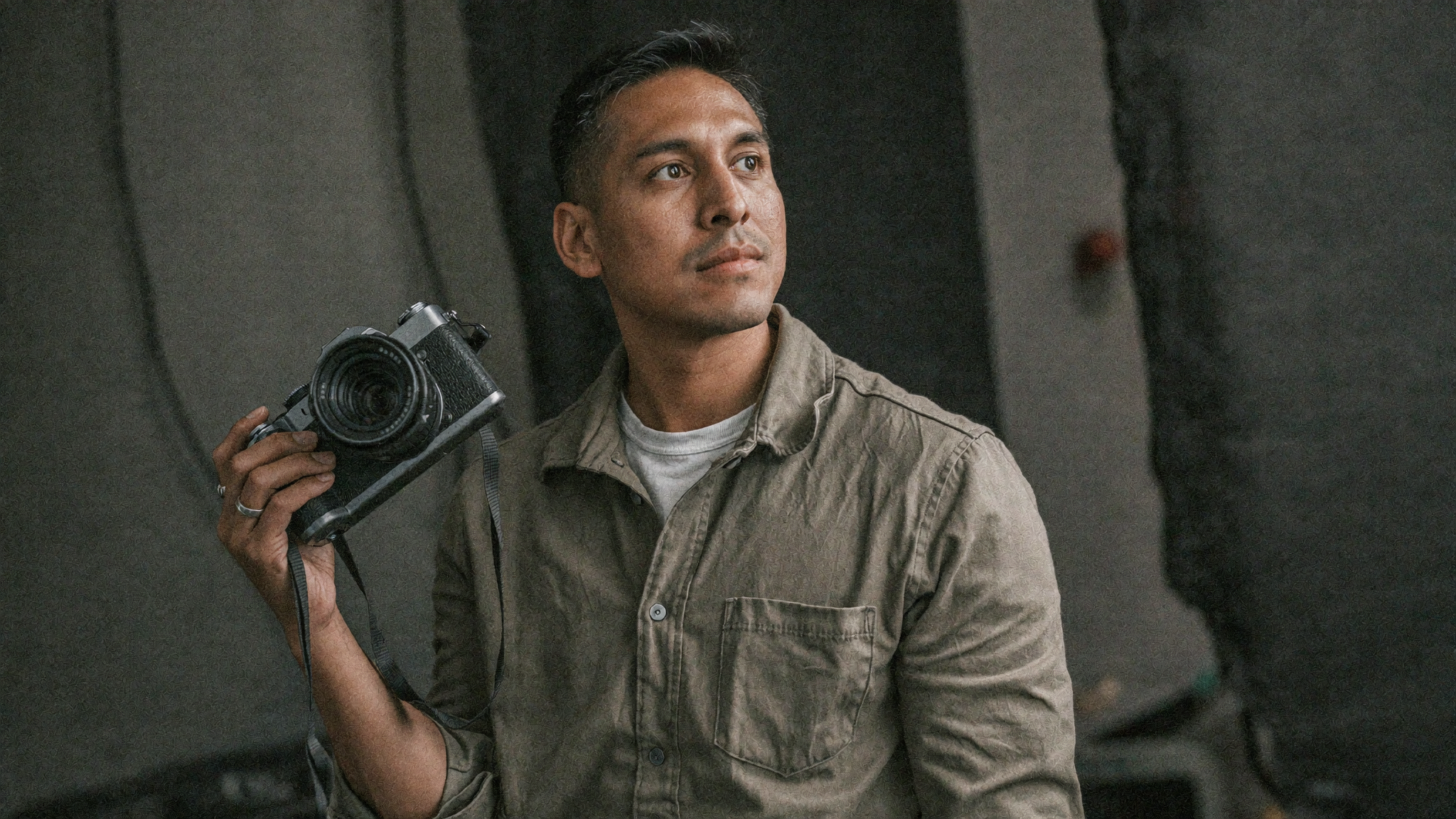
Most people point a camera at themselves to perform. I point it at people to catch them evolving. My whole art direction comes down to that difference. I am not chasing "look at me." I am chasing "I wonder what happens if I try this." That small shift, from performing to noticing, is where the real footage lives, and everything I do behind the camera is built to protect it.
Why do I make people talk to the camera the way I do?
It started with watching creators who are simply conversational on camera. One who got me thinking recently was Allan Peters, a logo designer who just sits and talks through how a design evolved, plainly, like he is thinking out loud. No polish, no pitch. That is the tone I chase. When someone stops performing and starts thinking out loud, the camera stops being a stage and becomes a mirror. That is when you actually see them.
What movies taught me about showing a person's inner world
Film has been solving this problem for decades, and I borrow from it constantly. There are two tools I lean on.
The first is the spoken confession. In High Fidelity, Rob talks straight to the camera and narrates his own romantic patterns, catching himself in the act of being himself. Fight Club takes it further: the narration is not describing the story, it is the character's mind coming apart in real time. The voice is the psychology.
The second is the visual reveal. Scott Pilgrim externalizes what a person feels with on-screen text and graphics, so you see the inner world instead of only hearing it. And there is a famous scene in Annie Hall where two people make small talk while subtitles show what they are actually thinking underneath. That gap, between what someone says and what is really going on, is the most honest thing you can put on screen.
I am doing the live-action, real-person version of all of that.
Why I pause people, pick odd angles, and keep it unperfect
When I film someone, I pause them on purpose. I let the silence sit. I shoot from an angle that is a little off, and I keep the imperfections instead of sanding them down. None of that is an accident. A clean, perfect frame flatters a person. An unperfect one reveals them. The pause is where they stop reciting and start actually thinking. The odd angle is where they look like a real person instead of a headshot. I am directing for the moment the mask slips, because that moment is the whole point.
Why evolution is the thing that lasts
Here is why I care so much about catching people mid-change: change is what survives. The artists who last are the ones who kept evolving with their audience. Bon Jovi stayed relevant for decades by refusing to stay the same. The Beatles grew up in public, moving through genres and generations, and their audience grew with them. That is the model. When I work with a brand or a person, I am not trying to freeze who they are today. I am trying to document who they are becoming. There is a foundation, I understand it, and then I help it evolve. I do not claim to know it all. I watch what is happening in culture, and I move it forward.
That is my art direction in one line: catch people while they are still changing, because that is the only version of them worth keeping.