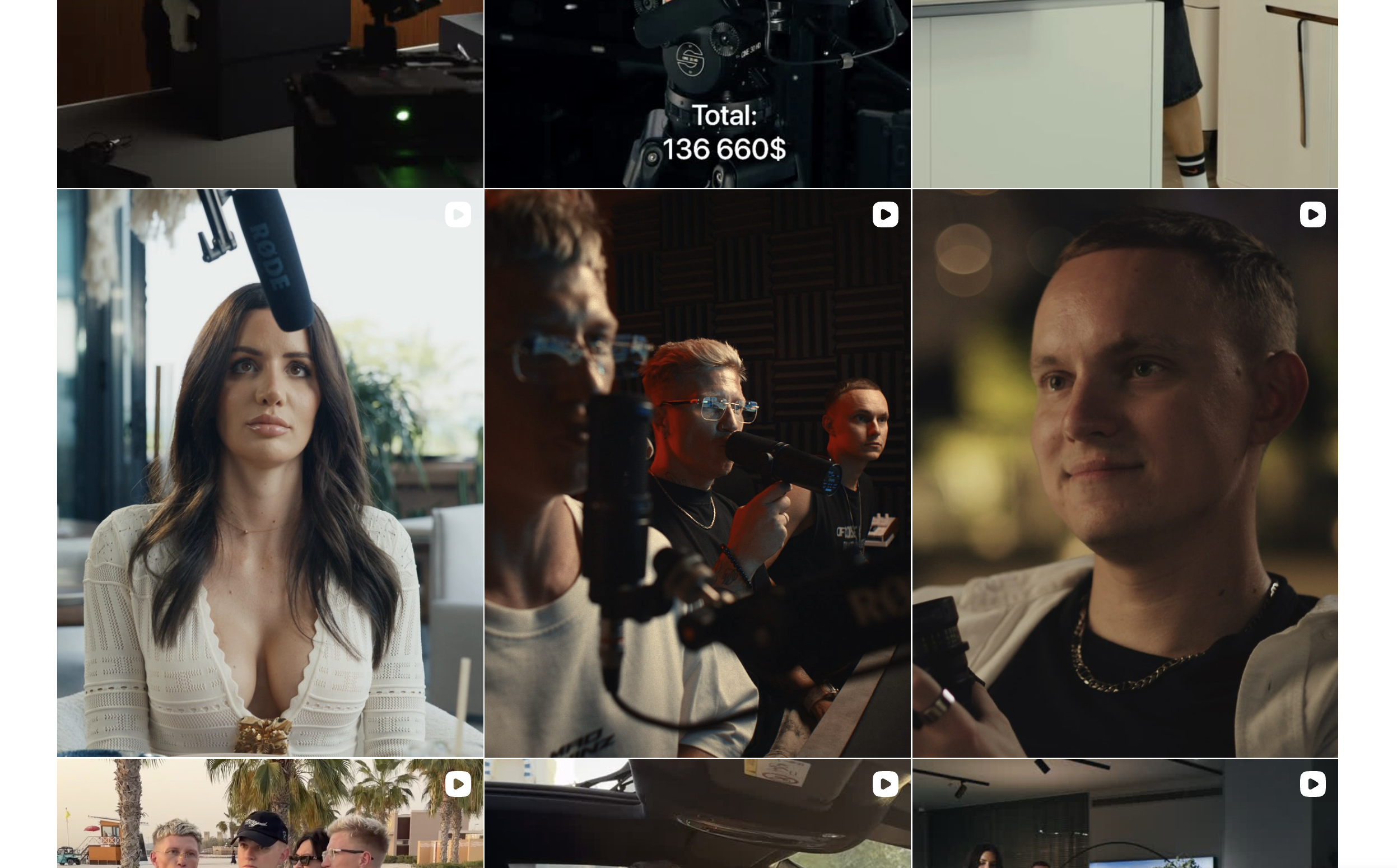
There's a director named Andrey Kovalev, @qval_director, who posts short cinematic sketches that are less than two minutes long and tell a whole story. My favorite: he's on a date, a woman asks him to take a photo of her and her food, and because he's a director, a full film crew, gaffer, boom operator, and food stylist materialize out of nowhere to shoot it in cinematic quality. It's hilarious, it's memorable, and it's secretly the smartest kind of marketing there is, because the joke only works if the work is genuinely that good. That's the lesson: showing your craft, memorably, is the marketing.
I don't know whether to feel jealous, inspired, or both. Probably both. There are a ton of creatives who constantly inspire me, but this one stopped me cold, because you can see the entire skill set on display in a thirty-second gag.
Who is @qval_director?
Andrey Kovalev is a Dubai-based director who founded the production company Qval Film and the rental house Qval Rental, with a following north of 180,000 on Instagram. He's shot for major recording artists and global brands. In other words, the sketches aren't a substitute for a career, they sit on top of a real one. That's the part people miss when they try to copy this.
The sketch that stuck with me
He's at dinner, on a date. The woman across from him kindly asks, "Do you mind taking a photo of me and my food?" He smiles and says, "Sure." Then a cinema-grade camera rises up out of nowhere, not a phone, and an entire production crew floods in. A microphone. A gaffer. A food specialist plating and finessing the dish. He shoots a few seconds of the food and it looks absolutely incredible. Then it cuts back to the table, and she says, "I'm gonna put this on my Instagram story." The whole thing is shot like a film, not like a phone clip, which is the joke and the flex at the same time.
Why does this kind of content actually work?
Because it's a demonstration disguised as a joke. That single date sketch probably cost fifty thousand dollars or more once you count the crew, the equipment, the direction, and the edit, and every dollar of it is visible on screen. So the content does three jobs at once: it entertains, it's memorable enough that you send it to a friend, and it proves exactly what he can do. It's a portfolio, an ad, and a punchline in the same two minutes. When your craft is the funniest part of the video, the video sells the craft for you.
What can other creatives take from it?
You don't need a Dubai crew and a fifty-thousand-dollar budget. You need the underlying move: show your craft in a way that makes people remember it and instantly understand what you do and why you're different. That's the whole game right now. The content that's winning isn't the content that talks about the work, it's the content that is the work, performed in public. It's the same idea I keep circling back to in why every company needs a media arm: your skill isn't just what you sell to clients, it's the most convincing marketing asset you own. And it rewards the kind of creative risk-taking I leaned on with my own wedding content sprint, try the thing that's a little ridiculous, because ridiculous is memorable.
So, jealous or inspired?
Inspired. Watching someone use their craft this well is a gift if you let it be one instead of a threat. If you're learning how to get inspired, study the people who make you a little jealous and ask what, specifically, they're doing that you're not. For me the answer is obvious: he's not hiding the work. He's putting all of it on screen and trusting that the skill speaks. That's phenomenal, and it's worth remembering.
Watch his work: @qval_director.